Beyond Cost Per Ton: Modeling the Herd-Level Return of EPA/DHA Omega-3s
How Strata and EnerG-3 can be evaluated through milk response, retained pregnancies, calf value, and total herd-level return.
When feed costs are under pressure, cost per ton gets a lot of attention. That is understandable. Every ration decision has to make economic sense, and fat supplements are often one of the more visible line items in a feeding program.
But cost per ton does not tell the full story. For dairy producers and nutritionists, the better question is: what does the product need to return?
That return may come through milk response, improved reproductive performance, retained pregnancies, calf value, or a combination of several outcomes. And in today’s dairy economy, those reproductive outcomes may matter more than ever.
Reproductive value has changed
Milk price remains important, but reproductive economics have shifted. With beef-cross calves and blended calf outcomes worth more, each additional retained pregnancy can generate meaningful revenue.
For many herds, calf value is no longer a small side benefit; it can be a major part of the return equation. In some scenarios, additional retained calves can equal several dollars per hundredweight when spread across annual milk production.
As a result, nutrition and reproduction should not be evaluated separately. A nutrient that supports both milk response and reproductive outcomes can create value in multiple ways.
This is especially relevant when evaluating EPA/DHA omega-3 nutrition. Rather than asking only, “What does it cost per ton?” the better question is, “How much milk response, reproductive improvement, or calf value is needed to justify the investment?”
Why we built the ROI calculators
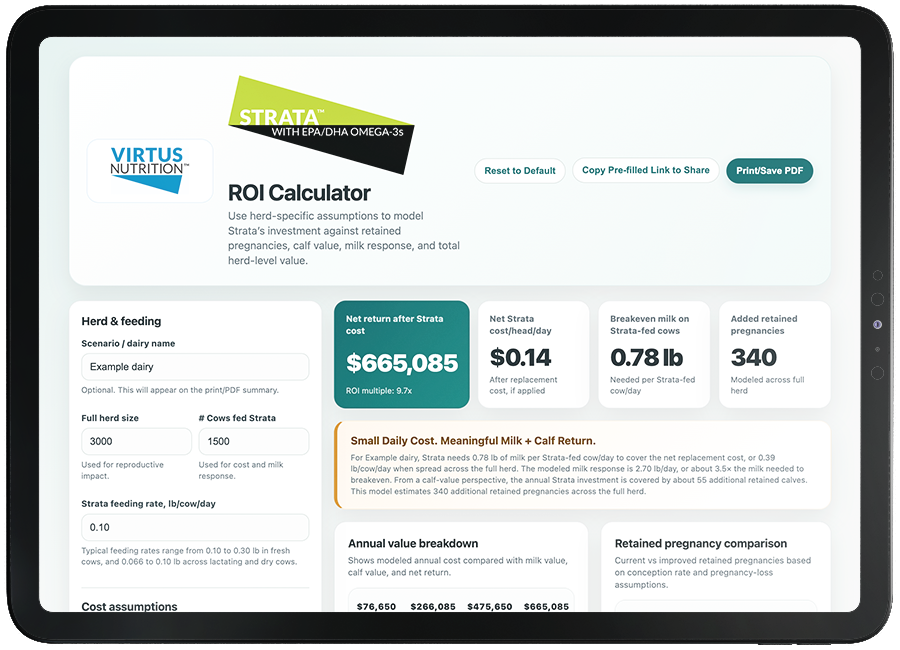
Virtus Nutrition developed ROI calculators for Strata and EnerG-3 to help dairy producers and nutritionists model these questions using herd-specific assumptions.
Producers can use the calculators to evaluate their own herd economics. Nutritionists can use them to help clients make more confident decisions, especially when producers are asking whether a product is still returning value under current milk, calf, and feed-cost conditions.
The calculators are designed to make the assumptions visible and adjustable. Users can enter their own herd size, number of cows fed, feeding rate, product cost, current fat supplement cost, milk price, milk response, conception rate, pregnancy loss, and blended calf value.
The goal is not to force one ROI number. The goal is to create a practical model that reflects the herd, ration, reproductive program, and market assumptions that are relevant to each individual dairy.
What the calculators estimate
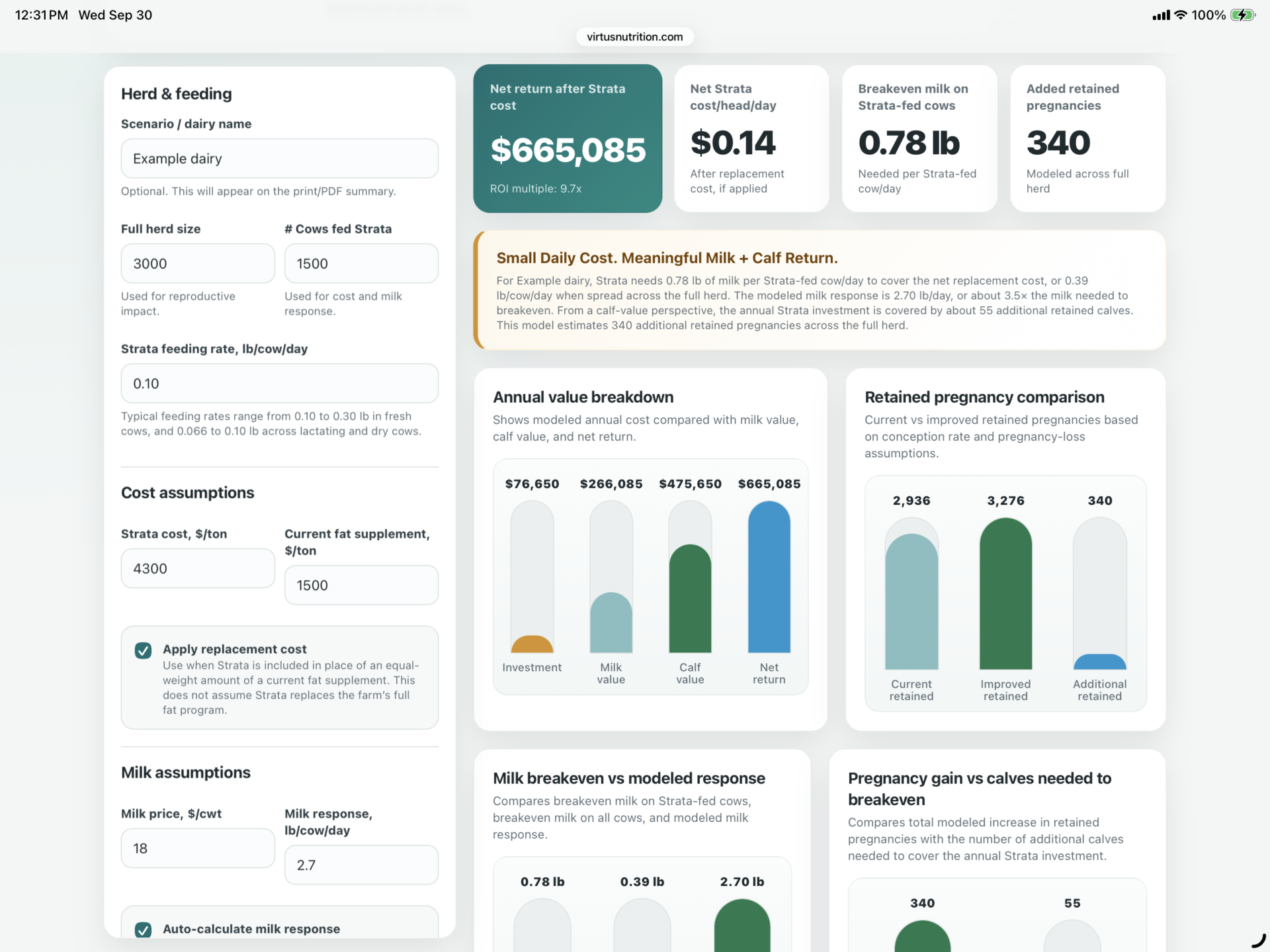
Both the Strata and EnerG-3 calculators model product investment against several potential sources of value:
- Net cost per head per day
- Replacement cost against a current fat supplement
- Breakeven milk response
- Milk response value
- Additional retained pregnancies
- Blended calf value
- Net return after product cost
- And ROI on the nutritional investment
Each calculator can also generate a pre-filled link for a specific herd scenario, making it easy to share assumptions with a producer, nutritionist, owner, or management team. A printable PDF summary can also be created as a leave-behind for nutrition reviews.
Understanding breakeven two ways
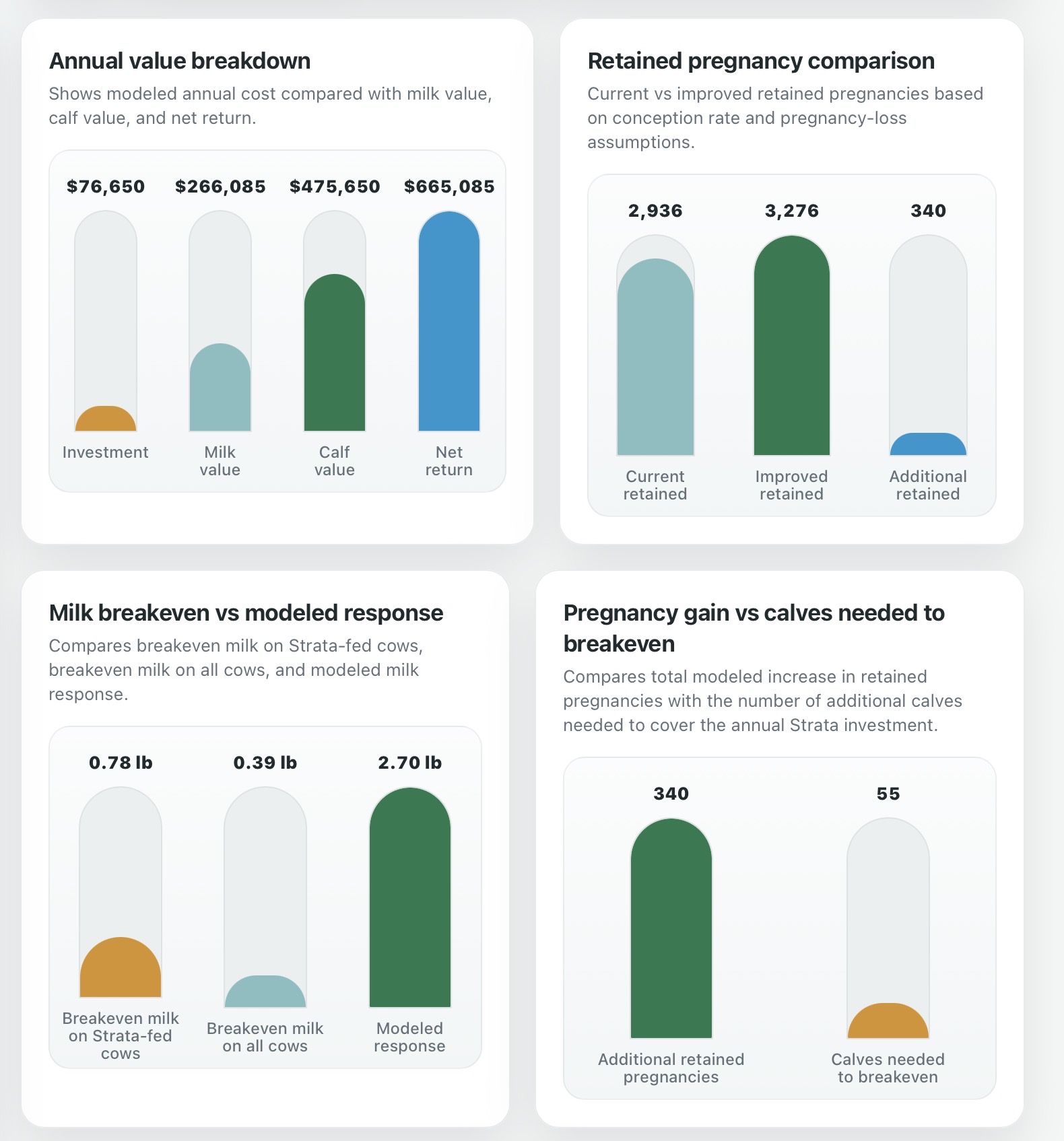
One of the most useful parts of the calculators is the ability to look at breakeven from both a milk and calf perspective.
These breakeven views are shown independently. Milk breakeven assumes milk response alone covers the annual product investment. Calf breakeven assumes additional retained calves alone cover the annual product investment.
In other words, the calculator is not saying a herd needs to breakeven twice. It is showing two different ways to think about the same annual investment.
For example, a dairy may be able to cover the product investment through milk response, through retained calf value, or through a combination of both. The total modeled return brings these values together, but the breakeven views help simplify the conversation.
Strata: concentrated EPA/DHA source
Strata is a concentrated source of EPA/DHA omega-3 fatty acids. Because of that concentration, it can be used at a lower feeding rate while still delivering targeted EPA/DHA nutrition.
The Strata ROI Calculator is especially useful when evaluating a targeted EPA/DHA strategy. In many cases, Strata may be fed to fresh and breeding pens, while reproductive impact is evaluated at the herd level.
The calculator models milk response on the cows fed Strata and reproductive value across the full herd. It also allows users to apply replacement cost when Strata is included in place of an equal-weight amount of a current fat supplement.
This helps producers and nutritionists evaluate Strata beyond cost per ton and instead focus on cost per head, milk breakeven, retained pregnancies, calf value, and total modeled return.
EnerG-3: fat replacement with added EPA/DHA value
EnerG-3 delivers EPA/DHA in a less concentrated form than Strata, while also providing a high-palmitic and high-oleic fatty acid profile. It is commonly used as a replacement for a farm’s current fat supplement.
The EnerG-3 ROI Calculator models that replacement cost lb-for-lb. Milk response is modeled from EPA/DHA equivalency and controlled research, while reproductive assumptions remain adjustable based on the herd and program being evaluated.
EnerG-3 may also support milk fat response depending on the ration and the fat supplement being replaced. To keep the model conservative and focused, milk fat value is not included in the current calculator.
That means any additional milk fat response may represent upside beyond the modeled return.
A practical tool for producers and nutritionists
These calculators are designed to be used in real conversations.
A producer can enter herd-specific assumptions to evaluate Strata or EnerG-3 under current market conditions. A nutritionist can use the tools during a client meeting, adjust assumptions together, and then send a pre-filled link or PDF summary after the conversation.
They are also useful for running “what-if” scenarios. What if milk response is lower than expected? What if calf value changes? What if reproductive improvement is more conservative? Testing those assumptions helps show the margin in the decision.
Instead of debating cost per ton alone, the conversation can shift to better questions:
- How much milk response is needed to breakeven?
- How many additional retained calves would cover the annual investment?
- What does the total modeled return look like using the herd’s own assumptions?
Default milk response and reproductive improvement assumptions are conservative estimates based on controlled research. Actual results will vary by herd, ration, reproductive program, milk price, calf value, market conditions, and management factors.
To review the supporting research or discuss herd-specific assumptions, contact Virtus Nutrition.